
Folklore

A variant classification platform for clinical genetics labs.

Clinical genomic interpretation

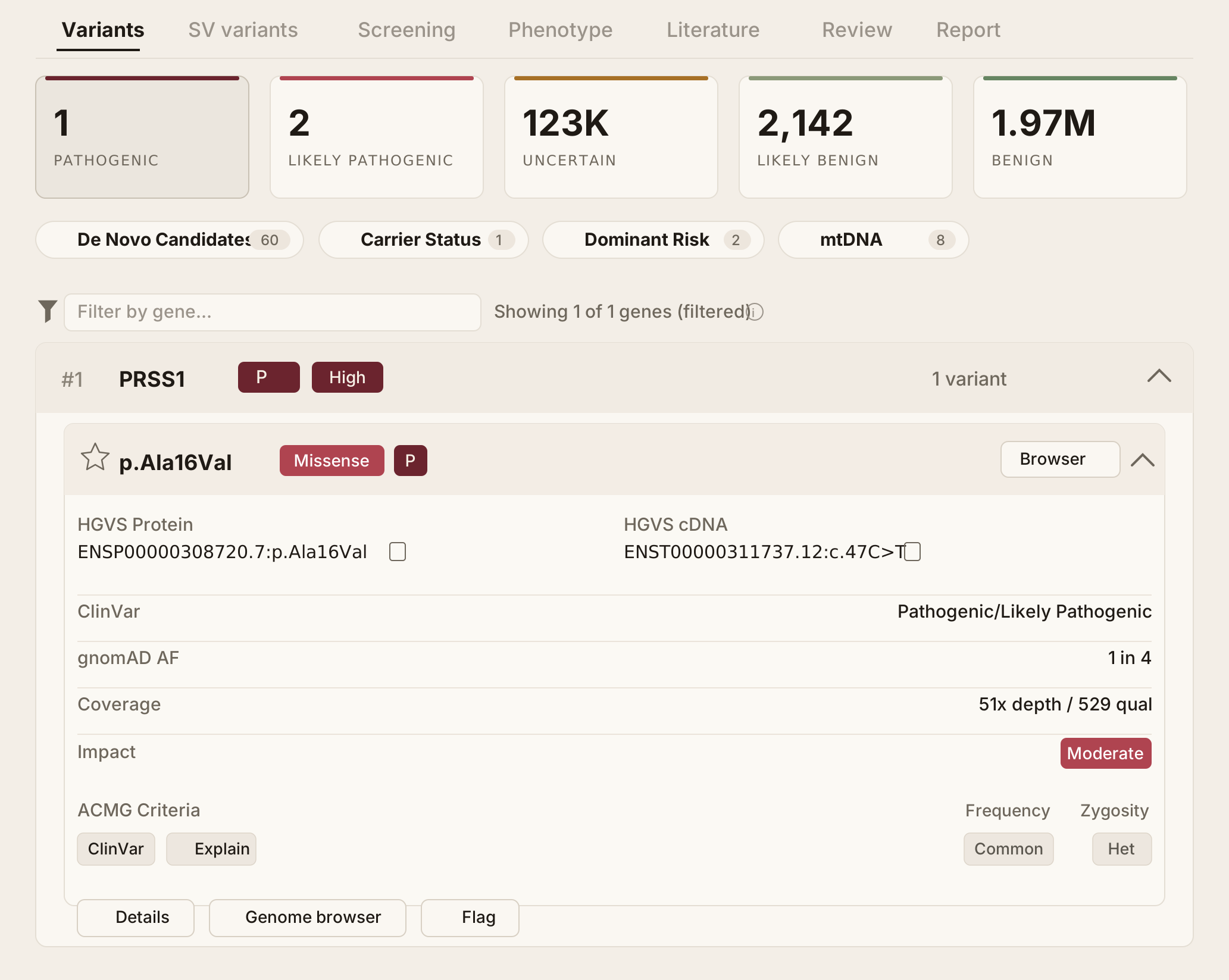
Folklore classifies and prioritises a whole-genome VCF in under 10 minutes. Nuclear variants, mtDNA, SV/CNV, phenotype, inheritance, screening and literature come together in one case view, with an AI-native assistant available throughout the workflow.

Methodology
Under 10 min

WGS classification
and prioritisation

8 modules

One integrated case record

AI-native

Full case context

Brochure
01 / 03

Featured videos: Folklore product overview, Folklore Reading the Genome, Folklore Woolen.

Workflow

From VCF to a signed, traceable report.

1

Ingest

VCF from WGS or WES enters with its sample and quality context.

2

Annotate

45 curated databases attach frequency, conservation, and predictions.

3

Classify

Deterministic ACMG/AMP, MMDWG and Riggs rules assign a class.

4

Prioritise

Phenotype, screening and cohort signals order the gene list.

5

Review

A geneticist inspects fired criteria and evidence, then signs.

6

Report

A tiered, traceable report carries every result to its source.

Modules

One story. Eight ways to read it.

Built for speed

A whole genome, ready for review in under 10 minutes.

Locally indexed reference data, parallel processing and framework-specific classifiers keep annotation, classification and patient-specific prioritisation inside one pipeline.

Local Indices

Reference data is available directly inside the analytical pipeline.

Parallel processing

Independent analytical stages run concurrently.

Case Output

Classification and patient-specific prioritisation arrive in one review workspace.

AI-native interpretation

Ask the whole case.

The assistant is available throughout Folklore and works from the context already assembled in the case: classifications, phenotype, inheritance, quality data and linked literature.

Could you please explain the findings and how they relate to the patient's phenotype?

The most significant finding is a Pathogenic variant in the AP5Z1 gene.

Pathogenic c.1033C>T (p.Arg345Ter)

Biallelic pathogenic variants in AP5Z1 are associated with hereditary spastic paraplegia type 48 (SPG48), an autosomal-recessive, often complicated form of HSP characterised by progressive lower-limb spasticity and weakness.

The geneticist reviews the interpretation and signs the report.
Clinical infrastructure

Built for routine
laboratory work.

Patient data remains in the EU. Access is role-based, data is encrypted in transit and at rest, and every classification records the evidence and classifier version used.

Data and privacy
EU data residency

Helsinki, Finland. Patient data stays in the EU.

Versioned evidence

Each result records its classifier version and supporting evidence.

Public methodology

Classification criteria, thresholds and decision rules are documented openly.

Qualified sign-off

Every final report remains under specialist review.

EU data residency
Encrypted
Role-based access
Decision support, not a diagnostic device
Not a CE-marked IVD
SCALABLE INTERPRETATION

Make interpretation as scalable as sequencing.

Bring panels, exomes and whole genomes into one fast, integrated and case-aware workflow, from VCF to specialist review.

Read the Methodology